
“What makes a desert beautiful,” said the little prince, “is that it hides a well, somewhere.”
– Antoine de Saint-Exupery
Although I have worked in collage since I was a child, I really began to explore large-scale, sculptural collage after the death of a dear friend and close collaborator ten years ago. The work was a way to cope with the grief but also an outlet to hope. This series comes at another time of loss, both personal and I believe collective. We now live in a time of ecological mourning and are in desperate need for paths to rediscover hope.
I began this work thinking about The Tommy Thompson Park and the Leslie Spit here in Toronto. This dump site of rubble and rebar on the shores of Lake Ontario, this “accidental wilderness” of trees, wildflowers, lagoons and submerged reefs. This decades-old landfill, re-activated habitat to migrating and mating birds and insects, amphibians and mammals. I gravitated to thinking about shore birds and waders, those stilt like birds astride that liminal space between earth, air and water.
While making this new body of work I also discovered the American poet and ecologist W.S. Merwin, (1927 – 2019). Merwin’s poetry speaks of memory and of loss, the continuum of time, ecology and hope. Working on eighteen acres of wrecked earth at his home on the island of Maui, W.S. Merwin created a garden of palm trees that became The Merwin Conservatory. The most bio-diverse garden of palm species in the world, was grown on land that was once ruined by pineapple plantations.
I find hope in making my work and in places of ruin where wildflowers grow, and in the poetry of those who have felt immense loss but continue to create.
– Jennifer Murphy, Toronto, September 2019

Poppy
cut paper collage made from images from used books
55h x 32w inches
2019

Glossy Ibis
collage - cut paper from used books stitched together with thread
32h x 70w inches
2019

Mirrored Damselfly
collage - cut paper from used books stitched together with thread
39h x 43w inches
2019


Pressed Daffodil
cut paper from used books collage
56h x 36w inches
2019

Climbing Leather Flower
cut paper from used books collage
57h x 30w inches
2019

Quartz Moth
collage - cut paper from used books stitched together with thread
29h x 46w inches
2019


Fading Rose
cut paper from used books collage
67h x 32w inches
2019
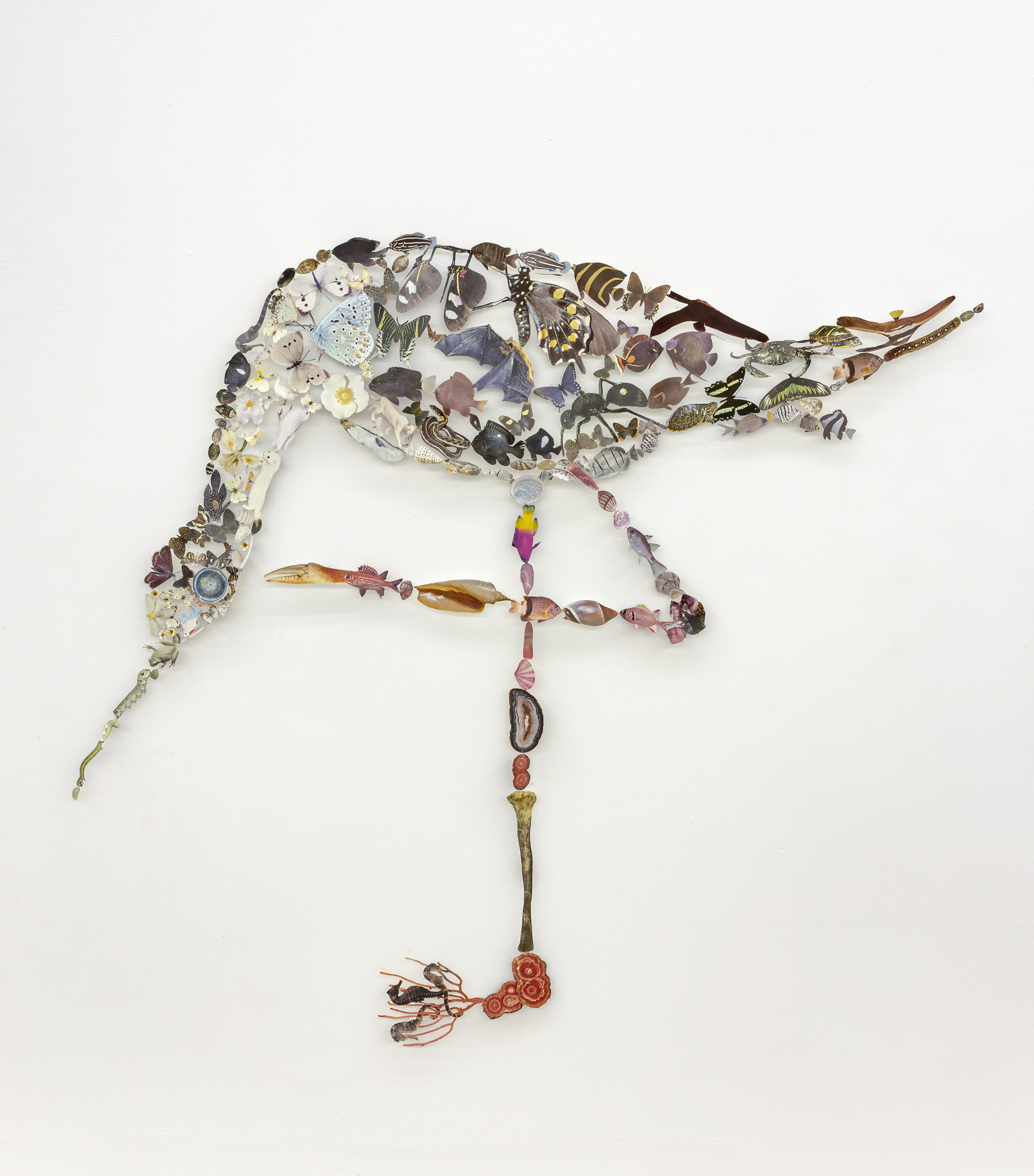
Long-Necked Avocet
collage - cut paper from used books stitched together with thread
60h x 60 w inches
2019

Blue Damselfly
collage - cut paper stitched together with thread
36h x 39w inches
2019


Proteus
collage
55h x 32w inches
2019

Great Egret
collage - cut paper stitched together with thread
62h x 78w inches
2019
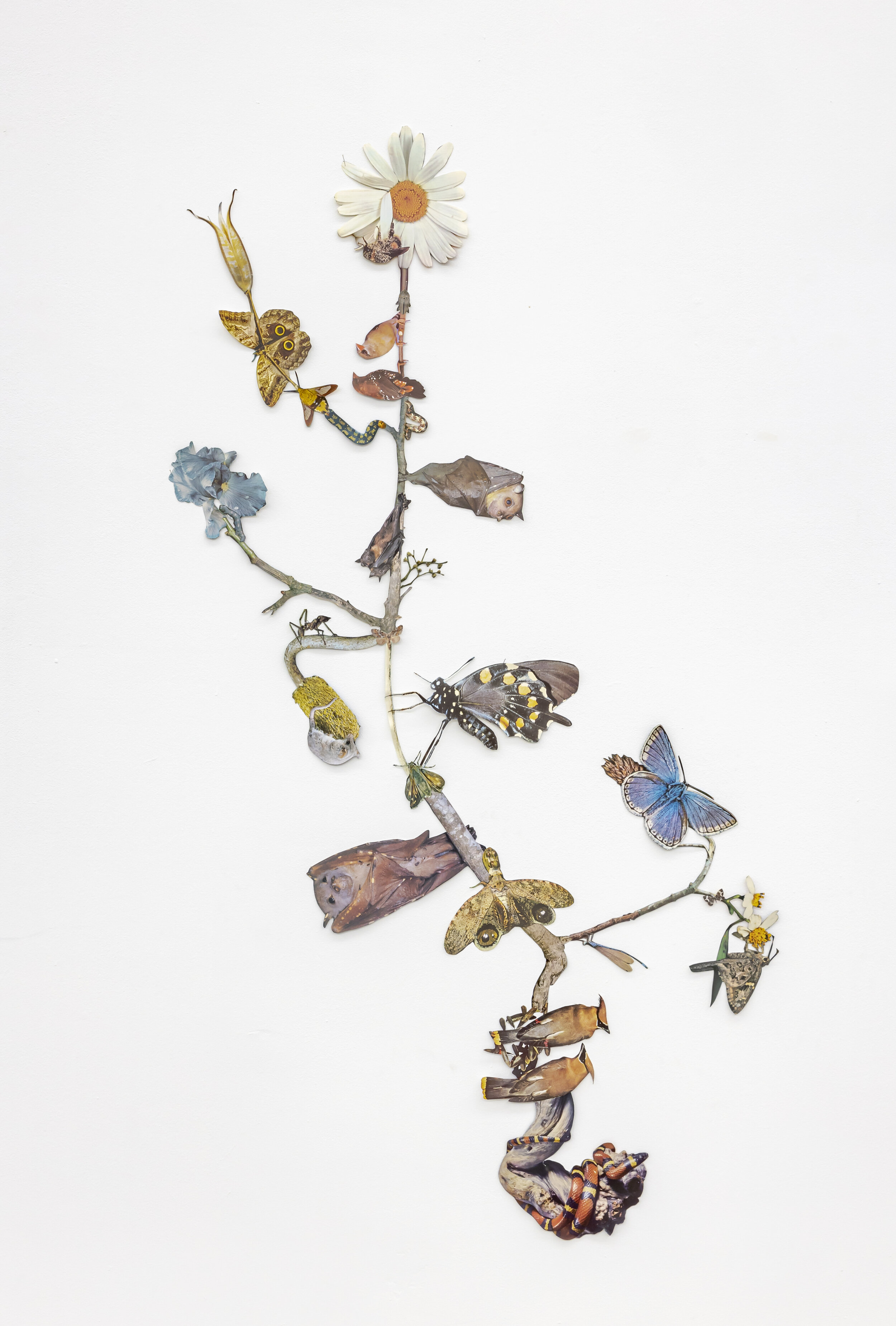
Daisy
collage
67h x 38w inches
2019

Golden Moth
collage - cut paper stitched together with thread
22h x 33w inches
2019


The Shadow of Sirius
second hand shell collection on black sand
108 inch diametre
2019

Purple Tigress
collage and shell framed in a 3” deep shadow box
25h x 17w inches
2019

Blue Fossil
collage and shell framed in a 3” deep shadow box
7h x 12w inches
2019

Patinated Flamingo
collage and shell framed in a 3” deep shadow box
25h x 15w inches
2019

Sunken Spoonbill
collage and shell framed in a 3” deep shadow box
25h x 12w inches
2019
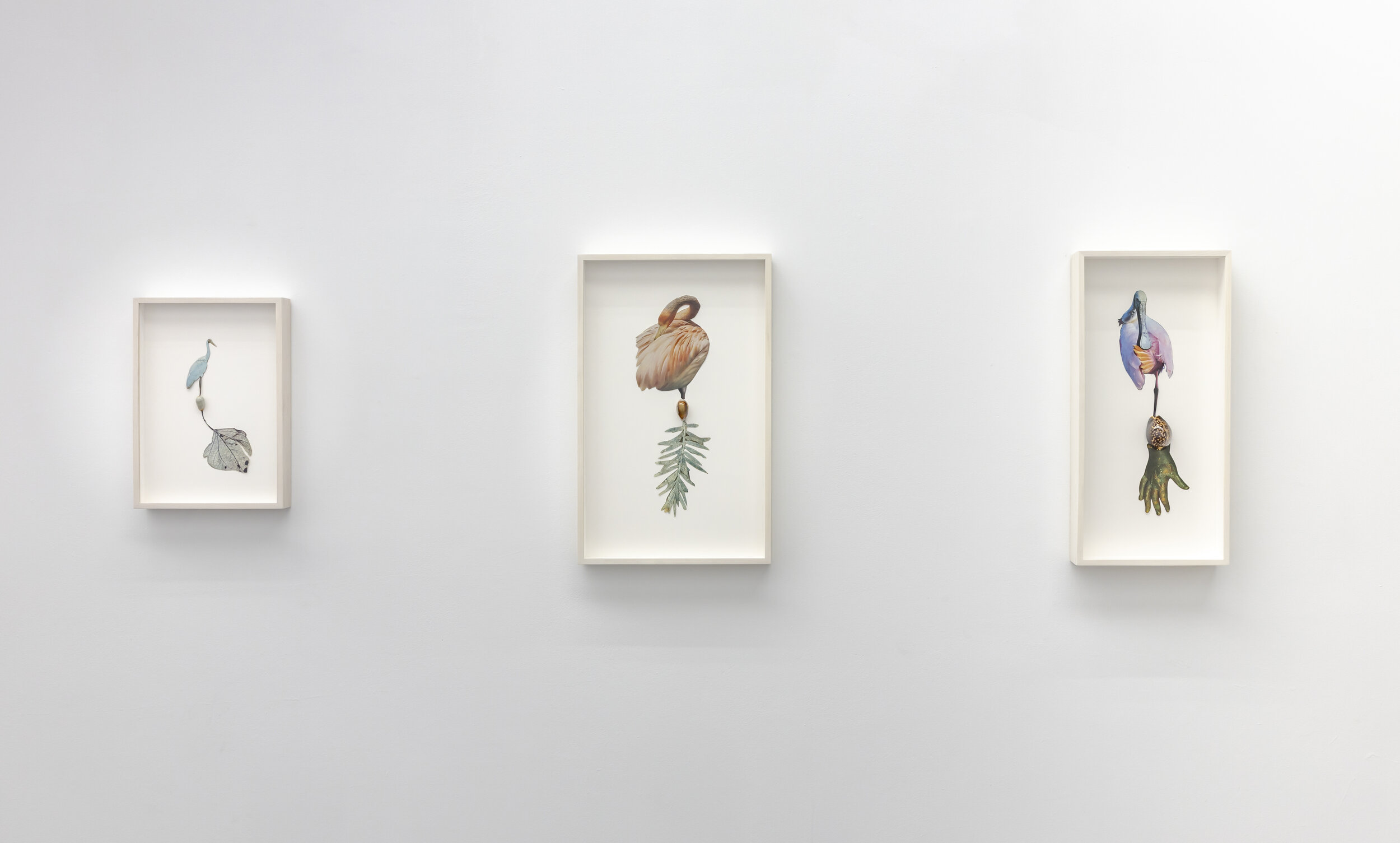

Green Fossil
collage and shell framed in a 3” deep shadow box
29h x 17w inches
2019

Gilded Ship
collage and shell framed in a 3” deep shadow box
29h x 15w inches
2019
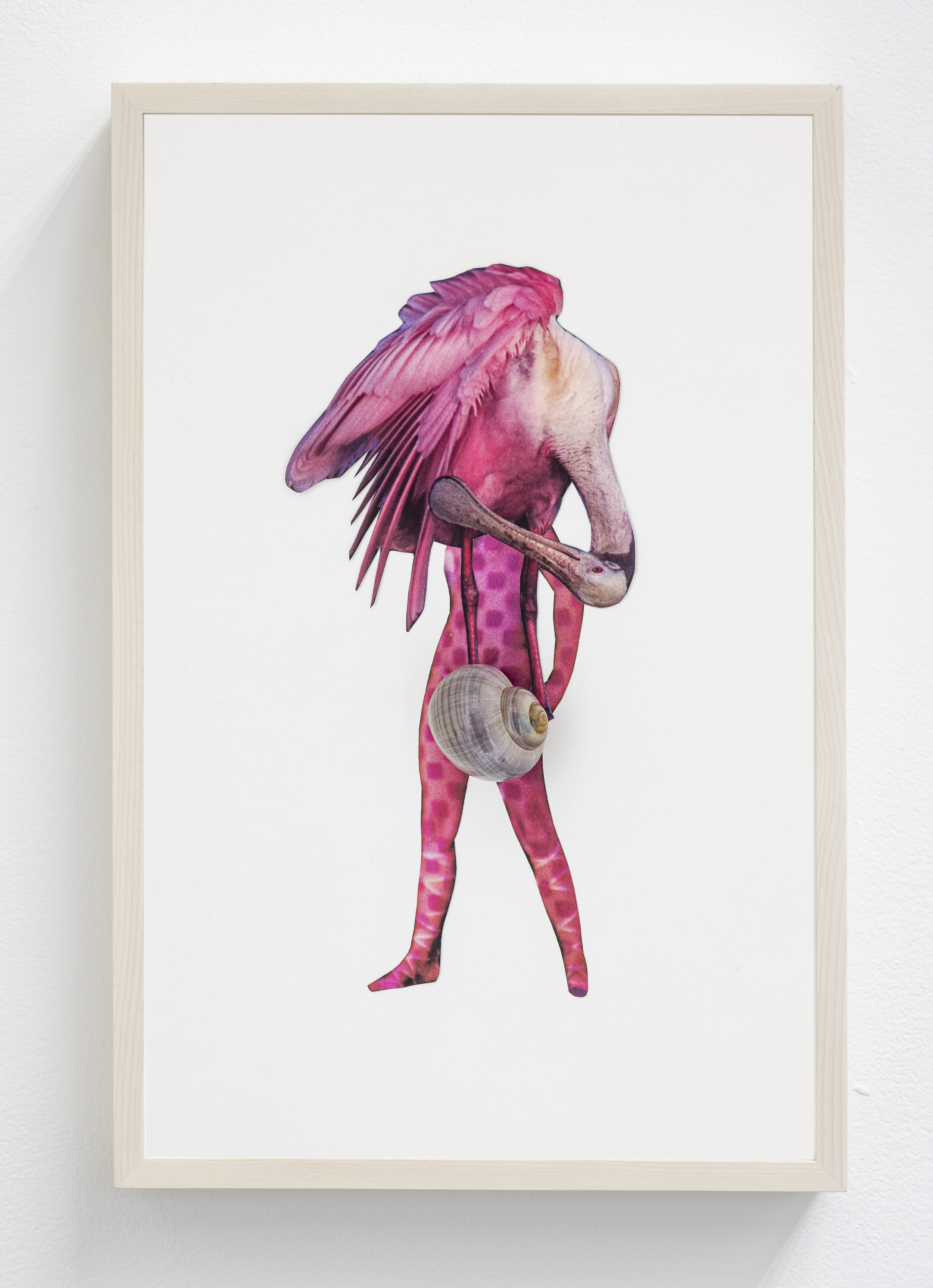
Painted Lady
collage and shell framed in a 3” deep shadow box
17h x 11w inches
2019

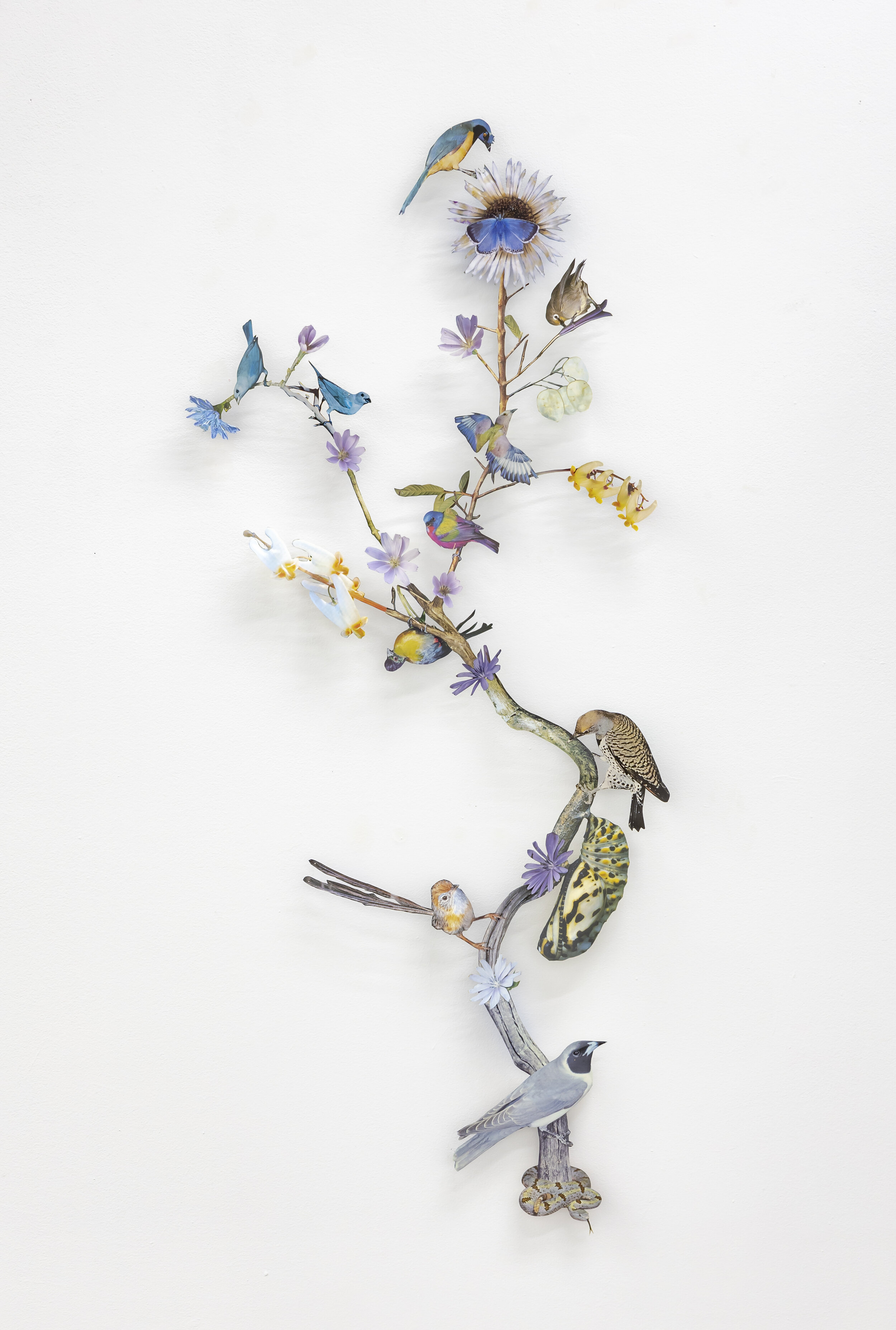
Inflorescence
collage
59h x 25w inches
2019

Peacock Iris
collage
90h x 50w inches framed
2019
Peripheral Review
The Shadow of Sirius: Jennifer Murphy at Clint Roenisch
By Penelope Smart
The moment at evening
when the pictures set sail from the walls
— excerpt from “Cargo” by W.S. Merwin
Pictures on the wall in Jennifer Murphy’s The Shadow of Sirius stand tall and still. In the gallery, jewel toned birds, moths, dragonflies, frogs and flora of human-scale have migrated from a dream-like state or have been grafted from the pages of a children’s storybook. Except—as in a Grimm’s fairy tale—prettiness tends to couple with death. Murphy’s exquisite creatures came to life within our new countdown: one in which our time-frame for saving the planet can be counted in months (131), not years. As an exhibit that was mounted in the autumn of 2019, a few weeks after Iceland held its first funeral for a glacier and a few months before Australia’s skies turned red from its burning shorelines, Murphy’s silent gathering of animals, insects and flowers—borne from love, anxiety and heartbreak—take on the power of a silent vigil.
Mercifully, these works are not without grace. The Shadow of Sirius calls upon a collection of poetry of the same title by W.S. Merwin (1927 – 2019), an American poet and ecologist who lived on an Hawaiian pineapple plantation, a once-ruined patch of earth that he restored into a palm tree conservatory. Merwin’s devotion to biodiversity and deep ecology was a heart-centered and painstaking exercise. His poetry—sparing lines of stillness, self-possession and dignity—show us how natural rhythms and infinite connections meant (in a very real sense) the world to him. Like Merwin’s words, Murphy’s work speaks to a great measure of conviction and care. Merwin placed trust in nature’s immensity and impartiality; at the end of his poem “Grace Note,” he writes, “almost at the year’s end / a feathered breath a bird / flies in the open window / then vanishes leaving me / believing what I do not see.”
There has been a special observance of birds. The kind with long legs and impossible S-curve necks: herons, egrets, avocets, cranes, and flamingos. Pink shorebirds are always eye catching, and the flamingos in Painted Lady (2019) or Patinated Flamingo (2019), as part of a flock of small collages of paper and shell, flaunt Murphy’s surrealist tendencies. Even her flowers, Poppy, Fading Rose, or Daisy (all 2019) are much more than innocent blooms, more like regal beanstalks, lavish and leggy. Though, it is Murphy’s Long-Necked Avocet, Glossy Ibis, and Great Egret (all 2019) who, on stilt legs, hold court in the main gallery room. Drawn from the richly illustrative vision of nature found in John James Audubon’s Birds of North America—it is as if Murphy, more than the 19th century artist-naturalist, knows the truth of rare shore birds, such as a heron. They are creatures who stake claim to the realm of the imagination. Adapted to be well-hidden at the edge of earth and water and sky, it is hard not to gasp if you see one.
Even though Murphy’s work consistently looks like it was made by a magic spider, her signature collage technique is disarmingly simple: hand-cut images from nature magazines and textbooks are sewn together into exquisite design. The effect is ornamental; insects as finery. As with the time-consuming work of ornamentation—fine lace work, embroidery, even calligraphy and scrollwork—the level of skill and effort required of the maker of work borders on the sacrificial. High-level precision and dedication is nothing new in her work, but these pieces show Murphy as an artist ambitious in her craft and owning new webs of death and life; hope and worry; hours and hours of it. Stand back and Quartz Moth (2019) is an object: a giant gemstone brooch. Get up close and the insect becomes a two-dimensional web of itself, a teeming network of magic-dust wings and tiny swamp things. Her caretaking of paper and compositions of nature is now so indexically-enlightened yet nonsensical, so and inexhaustible it can make you feel dizzy. Nauseated. Hypnotized. Do I look away? Suddenly terror of beauty and grandeur of tragedy comes crashing in.
Murphy treasures the ocean, moon, and tides. In the centre of the room is a spiral made of shells, corals, abalone—every sort of pastel skeleton or glinting husk of the sea—upon a circular plinth. The show’s namesake sculpture is yet another of her impeccable amassments and arrangements of a singular type of thing. In form, Murphy’s is a coil connected to Smithson’s Spiral Jetty (1971), in content, however, the work floats away (or above) the masculine history of western landart, and towards the mystery of moon cycles or the sentimentality of shellcraft. Gazing at The Shadow of Sirius (2019), there is, above all, a sense of the infinite. There are no cardinal directions and time catches everything in its whorl.
As if on a ten-year cycle, the imagery in this exhibit circles back to the large gemstone skulls, birds and spiral designs that filled Clint Roenisch’s Queen Street gallery in Twenty Pearls (2011). Since then, Murphy’s practice has both evolved and devolved into wondrous scatterings of mostly small, generative, anthropological-tinged works on gallery walls. While The Shadow of Sirius remains an open-ended sequence, this new body of work has emerged as her most biologically distinctive in years. Murphy’s Blue Damselfly (2019) or Golden Moth (2019) have not fluttered in on a whim nor do they carry playful traces of human origin. They are bound to an eye-level plane like flies on flypaper; they are history.
One concluding effect upon the viewer is that Murphy has the guts to go big. In similar fashion to floor-to-ceiling collage works of the twenty-first century, the most monumental being American artist Kara Walker’s exhibition Narratives of Negress (2003), what Murphy pins up is storytelling on a grand scale—one in which hierarchies of big and small, or real and imagined can be considered and questioned. The epic narrative, however, full of empty space, is one in which humans have been absented. More so, it is Murphy’s shore birds, on their eloquent limbs, who have consciousness and poise outside the maelstrom. At the end of the decade and the eerie rose dawn of a new one, Murphy’s birds are an embodiment of grace and pause—moments of stillness before the future takes leave in flight.
The Shadow of Sirius ran from September 5 – October 12, 2019 at Clint Roenisch Gallery in Toronto, ON.